




DesignX
As an educator and designer, I have spent many years creating meaningful learning experiences (LX/Instructional Design) that center students and foster engagement. Beyond the classroom, I also design logos, graphics, flyers, documents, and websites for academic and community-based projects. More importantly, I specialize in DesignX – initiating, conceptualizing, and implementing projects that drive positive changes. Below are selected past and current initiatives/projects that I have conceived/designed including both the initial vision and the full implementation.
Current Initiatives/Projects
VietTBLT (2025-Present) – Bridging Theory-Practice Gap in TBLT via Research, Pedagogy, and Community
Status: Ongoing | Timeline: 2025-2026 | Collaborators: Chung Nguyen, An Sakach

The VietTBLT Initiative focuses on advancing task-based language teaching (TBLT) for Vietnamese through three interconnected pillars: research, pedagogy, and community with a mission to create practical, research-informed instructional materials and foster a network of teachers committed to meaningful, communicative learning. See current and past projects https://www.viettblt.com/projects
GUAVA Refresh (2021-Present) – Professionalizing Vietnamese Language Teaching
Status: Ongoing | Timeline: 2021-2027 | Collaborators: Chung Nguyen, Thuy Tranviet

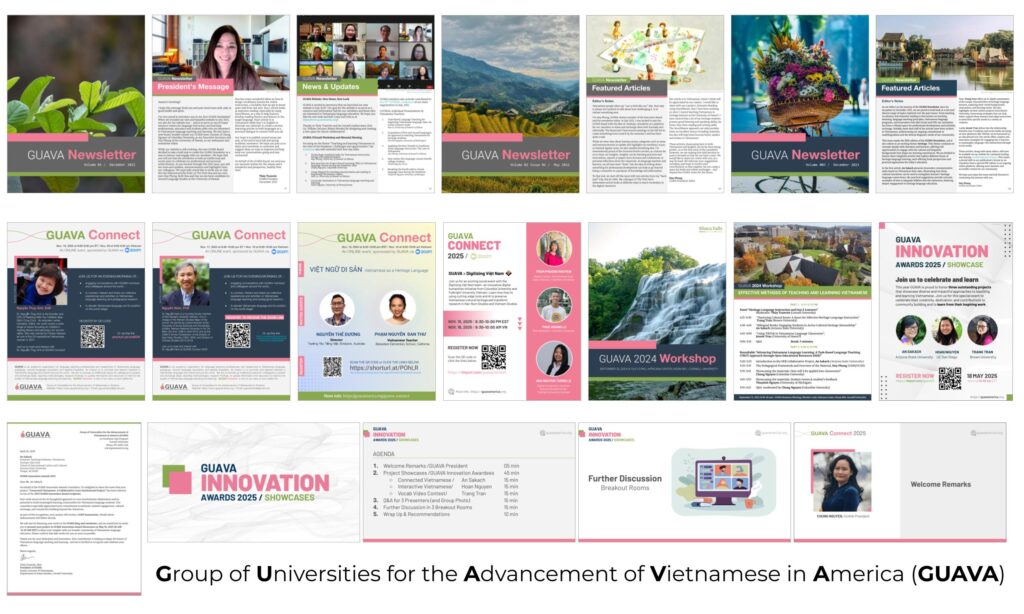
GUAVA = Group of Universities for the Advancement of Vietnamese in America
- Editing and designing the GUAVA Newsletter, a professional space for Vietnamese teaching professionals (six issues).
- Curating and publishing monthly e-Newsletters to keep members and friends staying connected. Sign up here to receive my monthly updates about Vietnamese language education via GUAVA.
- Serving as a board member of GUAVA and working closely with the board to initiate new changes (GUAVA Connect, Innovation Awards, Best Practices).
- Migrating the GUAVA website to open-source WordPress to serve as a resource hub for VLT. Designing, updating, curating resources.
Previous Projects/Initiatives
Taskbook as OER (2023–2024) – Intermediate Vietnamese : A Task-Based Journey
Status: Completed | Timeline: 2023-2024 | Collaborators: Chung Nguyen, An Sakach
This project addresses one of the most persistent and challenging questions in Task-Based Language Teaching (TBLT): implementation. Despite strong research support and a solid theoretical foundation in Second Language Acquisition, TBLT has not yet been widely adopted at scale. Frequently cited barriers include the lack of ready-to-use TBLT materials, concrete classroom examples, and sustained teacher education. My earlier work addressed these challenges in a deliberate, multi-dimensional sequence. I began by focusing on materials development, initiating efforts to build a repository of pedagogic tasks that teachers could adapt and reuse, including an unfunded proposal for an open resource book, New Ways of Teaching English with TBLT in 2017 and a funded project on Developing Task-Based Materials for Mixed-Level Vietnamese Language Classrooms in 2021. In parallel, I worked on teacher education by designing and teaching a “TBLT in Action” course for the Second Language Studies (SLS) BA program at the University of Hawaiʻi at Mānoa (proposed in 2019 and taught in 2021). Complementing these practice-oriented initiatives, my doctoral dissertation examined learner education in TBLT, contributing an empirical research perspective on how learners understand and engage with task-based interaction.
The idea of a task-based open educational resource (OER) fully crystallized when a colleague invited me to collaborate on a grant proposal to develop Vietnamese language teaching materials. I assumed the pedagogical lead and intentionally framed the project within a TBLT approach by designing what I coined a taskbook, a format positioned between a task bank and a traditional textbook, specifically aimed at supporting and facilitating TBLT implementation. I was responsible not only for conceptualizing the project from its inception through completion, but also for serving as the lead instructional designer to ensure pedagogical coherence, consistency, and a professional standard across all materials. The project was awarded a grant from the Less Commonly Taught and Indigenous Languages Partnership, funded by the Andrew W. Mellon Foundation and housed in the Center for Language Teaching Advancement (CeLTA) at Michigan State University. The outcome is a collection of high-quality, openly licensed Vietnamese language teaching materials grounded in TBLT principles. These resources are now used by major universities across the United States and internationally, contributing to broader access to task-based pedagogy and supporting teachers in implementing TBLT in real classrooms. Learn more about the project including the taskbook and related project activities at: https://sites.google.com/view/vietoer
Building on this work, I further collaborated with colleagues to co-found VietTBLT, an initiative created to provide a collaborative and innovative space for Vietnamese language instructors. VietTBLT supports teachers in learning, applying, and refining TBLT practices while fostering meaningful and sustainable connections with researchers, pedagogical experts, and fellow educators. Through this community-oriented model, VietTBLT extends the impact of the taskbook beyond materials development, positioning TBLT implementation as an ongoing, socially grounded process of professional learning and collaboration.
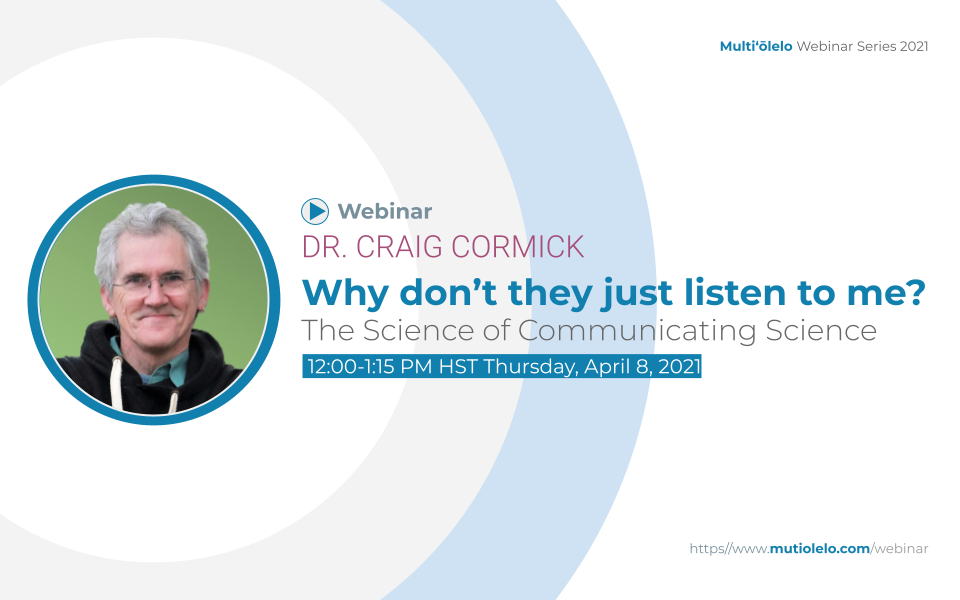
Multiʻōlelo Initiative (2018–2022) – Multilingual & Multimodal Language Research Communication
The Multiʻōlelo initiative addresses the research–practice gap in language education by reimagining how academic knowledge is communicated beyond specialist audiences. It began with my early interest in making research publications more accessible to lay audiences without formal training or backgrounds in language research. Initially, the focus was on supporting language teachers and educators by lowering barriers to research engagement. Over time, the initiative expanded to serve a broader audience, including students, researchers, and members of the public interested in language-related issues.
At its core, the project is grounded in a commitment to multilingual and multimodal research communication. By leveraging multiple languages and diverse modes of representation such as infographics, videos, slide decks, and web-based formats, the initiative challenges the dominance of English-only, text-heavy scholarly dissemination. This approach not only increases accessibility but also aligns research communication with the multilingual realities of language education and use.
Through sustained collaboration, experimentation, and community engagement, the initiative has evolved into a platform that supports open, inclusive, and socially responsive knowledge exchange. It positions research accessibility not as a matter of simplification, but as a design and equity issue, one that requires intentional attention to audience, language, and modality.
For my leadership in this work, I received two community service awards. Multiʻōlelo is now housed in the Second Language Studies department at the University of Hawaiʻi at Mānoa. Learn more: https://multiolelo.com
- Phung, H. (2023). Bridging the research-practice gap with Multiʻōlelo: An initiative for language research communication. AAALGrads Newsletter 7(2), 20-22.
- Phung, H., & Ortega, M., (2021, June). Promoting L2 research visibility and accessibility. Paper presented at the CALICO Virtual Conference. https://youtu.be/OgUJ0zFuap4
- Phung, H. et al. (2020). Using infographics for language research dissemination. Workshop delivered at the SLS Brownbag
- Phung, H. (2021). Multiʻōlelo Annual Review 2020. Report designed and published on the MO website. Retrieved at https://multiolelo.files.wordpress.com/2021/03/2020-multioleo-annual-review.pdf
- Phung, H., Choe, A., Diez-Ortega, M., Eguchi, M., Holden, D., Mendoza, A., & Nguyen, T. (2020). The Multiʻōlelo initiative for language research communications. Second Language Studies, 38(1), 5–17. DOI: 10.13140/RG.2.2.34737.20325
- Phung, H., & Reinagel, R. (2018, April). Multiʻōlelo platform: Showcasing multilingual voices in language learning and use. Proposal presented at the 22nd Annual Graduate Student Conference of the College of Languages, Linguistics, & Literature. University of Hawaiʻi at Mānoa, Honolulu, HI.
Whitelist of Open Access Journals in Language Studies (2015-2022)
Several backlists of predatory journals, conferences and publishers are available, but I want to maintain a whitelist of OA journals for those who are interested in learning more about language studies. Available at: https://airtable.com/shrlJXc3YKRm1ZwXs; If you know an open access journal unlisted in the list above, please recommend here: https://airtable.com/shrq3y56DhkTvGjJk
PBLL Symposium & VietTESOL (2016–2017) – Catalyzing Positive Changes in ELT in Vietnam
PBLL Symposium (2016-2018)
Initially created as a small professional learning group among project-based language teachers in the English Department, this initiative evolved into a university-level symposium series with innovative formats and strong faculty engagement. I led the design of the symposium experience—including the brand identity, conference program, visual materials, digital platforms, and communication strategy. These design layers helped shape PBLL into a recognizable and scalable learning community. The workshops attracted participants from across the member universities of Thai Nguyen University and were later expanded into a national conference for multiple languages. http://pbllsymposium.weebly.com
VietTESOL International Conference (2017)
VietTESOL 2017 asked a bold question: How might we redesign Vietnam’s national ELT conference to be more inclusive, dynamic, and teacher-centered? Building on the momentum of earlier PBLL initiatives, I helped conceptualize and organize VietTESOL 2017 using a new approach to conference design and teacher engagement. Despite the challenges of implementing a new model for the first time, the 2017 conference laid the foundation for what has since become one of Vietnam’s most active annual professional gatherings. VietTESOL 2017 website https://viettesol.weebly.com;
Community English Club & Brave Girls (2010–2016) – Student Empowerment & Leadership Development
Community English Club (2010-2014)

CEC began with a question: How might we design a student-led ecosystem for language learning that is creative, empowering, and enduring? I initiated CEC in 2011 and mentored its leadership team through 2014, designing not only the program structure but also its visual identity, public-facing communications, and digital presence, including graphics, posters, publications, and early websites.
Students co-created English game shows, volunteer-teaching programs, bilingual magazines, and campus-wide events. Many alumni now work in leadership positions, and the club continues to operate today(see https://www.facebook.com/CommunityEnglishClub). Student-produced work from this period can be viewed here: https://www.slideshare.net/cec12345; https://www.youtube.com/cecenglishclub; https://web.archive.org/web/20111009215500/http://cectn.net/cec
Publications and presentations from this initiative:
- Phung, H., Tran, N., & Hoang, D. (2023). Empowering students with authentic tasks to learn English beyond the classroom: A club-based model. Innovation in Language Learning and Teaching, 17(2), 191–201. https://doi.org/10.1080/17501229.2021.1998068
- Phung, H. (2016, April). Student empowerment in a community of practice: A case study of Vietnam. Poster presented at the Fulbright Enrichment Seminar. The George Washington University, Washington, D.C.
- Phung, H. (2012, May). Empower students with authentic tasks: A club-based approach to language learning. Paper presented at the Conference “Building English Teaching Capacity through Action Research and Innovative Practice” organized by U.S. Embassy Hanoi, National Foreign Languages 2020 Project, and Thainguyen University.
Brave Girls (2016-2018)

BraveGirls emerged from the belief that “educating one woman educates an entire family.” We designed a platform that nurtured confidence, leadership, and opportunity for young women. Beyond program development, I created the visual identity, communication materials, training content, and grant-funded deliverables, shaping the initiative’s voice and presence. Supported by the AIEF Alumni Engagement Innovation Fund ($25,000), BraveGirls became a collective space for empowerment. https://bravegirlsvietnam.wordpress.com; https://www.facebook.com/bravegirlsvietnam
Need a better design?
Get in touch for services, training, or consultation.